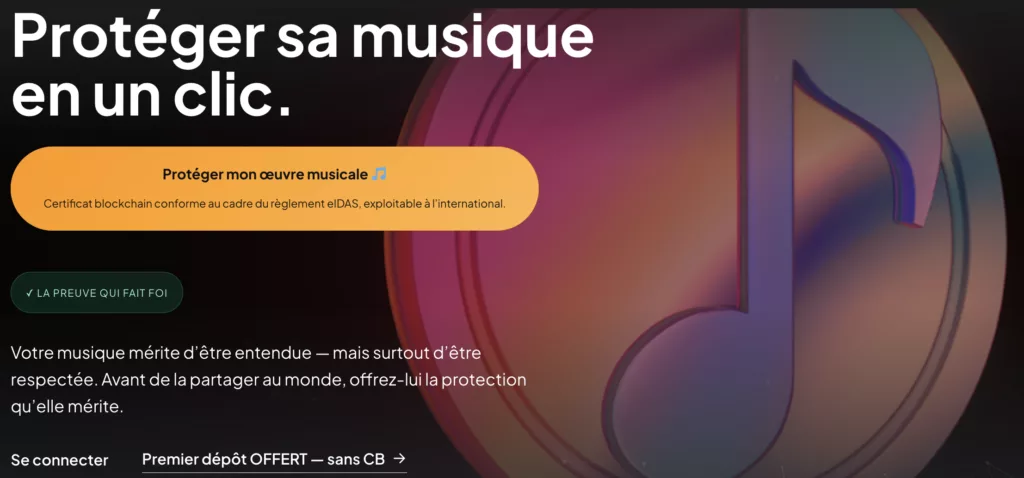


Deposit Your Music: Online Music Deposit to Protect Your Musical Creation
Copyright arises automatically, but in the event of a dispute, it's the evidence that mattersThis page provides a simple method to submit your creations (song, beat, lyrics, demo), choose a suitable solution, and build a credible portfolio — without unrealistic promises.
Note: this guide is informative (not legal advice). For serious matters, consult a legal professional.
Contents
If you read only one part: what to submit + when to submit + comparison.
→ Why Submit Your Music→ What to Submit (audio, lyrics, stems...)
→ When to Submit (before sending / before release)
→ Submit in 2 Minutes (Method)
→ Comparison of Solutions
→ Anti-Plagiarism: What It Does / Doesn't Do
→ FAQ
→ Resources & Links
Problem No.1: “I have the creation, but I lack proof”
Disputes often arise before even during distribution: sending a demo, unregulated collaboration, shared beat, topline sent to multiple places artists.
- Plagiarism / Uncredited Cover
- Conflict Among Collaborators (writers/producers/feats)
- Unable to Clearly Date a Version
Related Reading: Proof of musical authorship · Copyrights: Complete Guide
Why Submit Your Music
Submitting a song or beat serves to create dated proof (proof of precedence) which can strengthen your case if a dispute arises.
- You prove you owned a version on a specific date
- You secure submissions (labels, media, collabs, placements)
- You avoid disputes over “who did what” on a project
What Submission Is Not
Submitting your music does not “create” copyright and does not guarantee a legal outcome. It's one evidentiary element among others (contracts, exchanges, sessions, witnesses...).
🎯 Objective: make your portfolio defendable
To structure a collaboration: Essential contracts (2026)
What to Submit to Protect Your Musical Creation
Submit what best proves your work. A “good submission” isn’t necessarily a single file; it’s often a package (audio + text + proof of process).
Audio
- WAV/MP3 of the track
- demo/sketch
- instrumental version
- clean radio version
Writing
- lyrics (PDF/TXT)
- topline/melody
- score/lead sheet
- creation notes
Production
- stems/multitracks (ZIP)
- DAW project (ZIP)
- session screens/exports
- dated versions
“Submission Pack” Checklist (Recommended)
- 1 main audio (WAV/MP3)
- lyrics in PDF (if applicable)
- a stems/DAW export (if collaborating/beats)
- a “credits” file (writers/producers/features + contacts)
Tip: resubmit for key versions (final mix, final master).
When to Submit a Song or Beat
Simple Rule: Early + Key Versions
Submit early to date the origin, then resubmit when a version becomes “final”. This is particularly useful when several people are involved (production, topline, mix, mastering).
✅ Initial submission → ✅ “final master” submission
Submitting Your Music Online: The Easiest Method
For a quick online submission, the principle remains the same: create an account, upload, retrieve a certificatethen store your submissions in a library.
- Create your account
- Import your file (audio/text/zip)
- Retrieve your certificate/dated proof
- Archive your versions (library)
TuneLockr emphasises a timestamped certificate and a blockchain/eIDAS approach (see their documentation).
Before Submitting: Mini Anti-Plagiarism Check
If your goal is also to reduce the risk of conflict, you can start with an assessment. TuneLockr offers an "Anti-Plagiarism / Proof of Prior Creation" tool for educational use.
Important: a scanner alone is not "proof." It helps to prepare a case file.
Quick comparison: online music registration vs other options
There is no "one" perfect solution. The right choice depends on your context (budget, urgency, stakes). The goal: obtain an exploitable dated proof + maintain clean records.
| Solution | Objective | Who it's for | Key takeaway |
|---|---|---|---|
| Online registration (e.g. TuneLockr) | Quick dated proof + version archiving | Artists, beatmakers, producers, labels | Ideal if you want to register quickly and re-register key versions. |
| SACEM | Rights management/collection and distribution | Authors/composers/publishers | Complementary: useful for management, not a standalone "anti-plagiarism" solution. |
| Soleau envelope (INPI) | "Classic" dating of elements | Creators in a broad sense | Good administrative option, less fluid for multiplying versions. |
| Notary / Bailiff | Certain date / report | High stakes | Very solid but costly, often reserved for significant cases. |
For a "preparation + registration" approach: anti-plagiarism assessment → TuneLockr tool, then registration → TuneLockr app.
Anti-plagiarism: what the tool does (and does not do)
An analysis tool can help to assess the evidential strength of a file (prepare a file), but it doesn't replace: legal advice, nor a comprehensive comparison to all existing music.
- ✅ Helps understand good practices in technical proof
- ✅ Encourages registering the correct versions at the right time
- ❌ Does not "guarantee" the absence of plagiarism
- ❌ Does not replace a lawyer / expert in case of dispute
The right reflex: proof + organisation
The best "anti-plagiarism" system daily is having a process in place: archived versions, dated files, clear credits, retained exchanges, and regular deposits.
📁 A tidy file = easier defence
Beathoven Resources: Protect before SACEM · Proof of ownership
FAQ — Registering your music & protecting your musical creation
Is registering your music mandatory?
No, but it is highly recommended as soon as you share a work (demo, beat, topline, public release). Registration primarily serves to prove precedence if a dispute arises.
What should I prioritise for registration if I'm a beatmaker?
An audio export (WAV/MP3), a ZIP of stems/DAW project, and a “credits” file. Register before sending to an artist or before a collab.
Does TuneLockr replace SACEM?
No. SACEM focuses on rights management (collection/distribution). Registration/a dated proof aims to strengthen an ownership/precedence case. These actions can complement each other depending on your situation.
Is a registration enough in a dispute?
Registration provides a useful dated proof, but a strong case relies on other elements too: exchanges, sessions, contracts, witnesses, successive registrations, etc.
How to register quickly without getting lost?
Prepare your pack (audio + lyrics + credits), then register via the app: app.tunelockr.com. You can also run a diagnostic using the tool: Anti-Plagiarism Scanner.
Beathoven Resources (internal links)
Official TuneLockr Links (external tracked links)
- Access the app (register)
- TuneLockr Site (overview)
- Music copyright registration (guidelines)
- Anti-Plagiarism Scanner / proof of precedence
- Pricing & trial
Objective: register quickly, archive key versions, and keep an accessible dated proof.
Ready to register your music?
Start by protecting your musical creation (deposit + dated proof), and only then: promo, playlists, broadcast. A clear file saves you problems — and saves you time.
Tip: deposit before sending to a label / collaborator, then re-deposit the final master.