

Musical Plagiarism :
How to Detect, Prove
and Protect Your Music
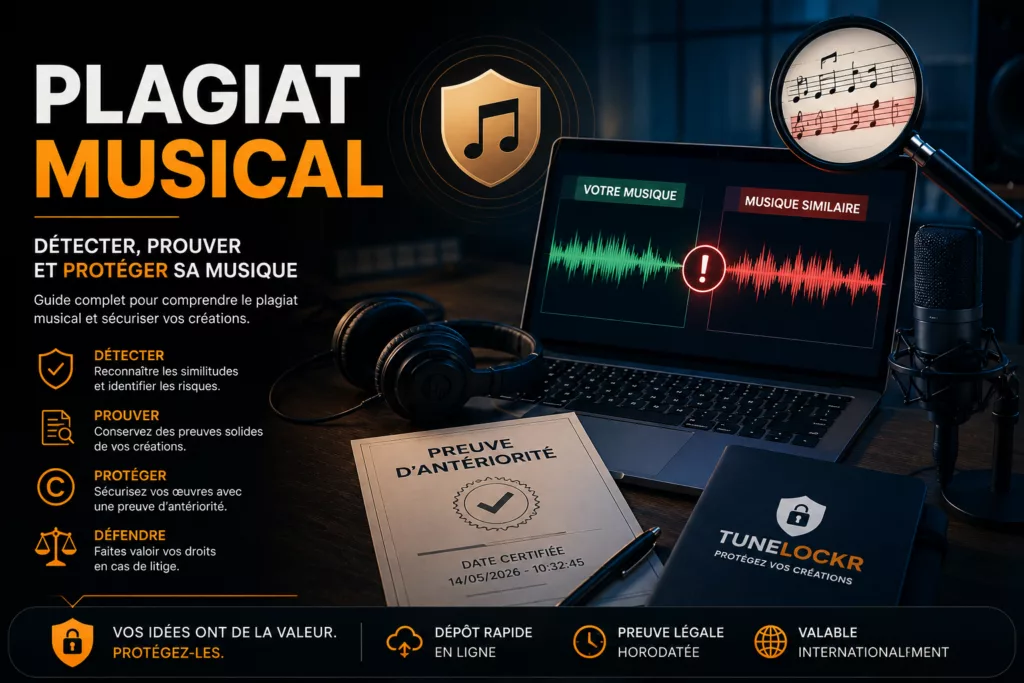
The music plagiarism is one of the most tangible threats to artists independents, beatmakers, and producers. This guide covers everything: exact definition, how to detect plagiarism, prove your precedence, what the law says, famous cases and most importantly — how to prevent it before it happens.
1) What Exactly is Musical Plagiarism?
The music plagiarism refers to the unauthorised and substantial reproduction of original elements of a work music that already exists. It can involve a melody, an original harmonic progression, lyrics, an arrangement, a distinctive rhythmic structure, or a combination of several of these elements together.
What distinguishes musical plagiarism from a mere resemblance is the intersection of two conditions:
Substantial Reproduction
The elements reproduced must be significant and characteristic — not anecdotal or common to an entire genre.
Proven Prior Existence
The copied work must exist before the work that copies it, and this prior existence must be demonstrable.
Originality of the Source Work
Only original elements are protectable. Common chord progressions or standard structures are generally not.
Important: a resemblance is not enough to constitute musical plagiarism. In France both in France and internationally, the analysis focuses on the entire work — melody + lyrics + arrangement + production — and not on a single isolated element.
Which Musical Elements Can Be Plagiarised?
| Element | Protectable? | Details |
|---|---|---|
| Original Melody | Yes | One of the most protected elements. A distinctive and original melody is at the heart of most plagiarism cases. |
| Lyrics | Yes | Protected as a literary work. Even partial reproduction of original lyrics can constitute plagiarism. |
| Original Arrangements | Yes | An original and distinctive arrangement is protectable if it reflects real creative contribution. |
| Standard Chord Progression | Generally not | I-IV-V-I, I-V-vi-IV… belong to the public domain. Only their combination with other original elements can be protected. |
| Characteristic rhythm/groove | Depending on context | Difficult to protect alone, but it can be considered in the overall analysis of the work. |
| Unauthorised sample | Direct infringement | Using a sample without clearance is not "plagiarism" in the strict sense but constitutes direct copyright and neighbouring rights infringement. |
| Song title alone | Generally not | A title on its own is not protectable by copyright (too short). However, it can be protected under trademark law. |
2) Inspiration vs musical plagiarism: where is the line drawn?
Musical creation is inherently cumulative. Everything artist draws inspiration from what already exists. The question is not "have you listened to this music?" but "have you substantially reproduced original elements of this music?"
The spectrum of musical similarity
Stylistic influence — Legal
Drawing from a genre, an era, or an artist to create something new. This is the foundation of all artistic creation.
Non-substantial resemblance — Grey area
Two pieces share a similar chord, rhythm, or vibe without reproducing original elements. Generally not plagiarism.
Substantial resemblance — High risk
The main melody, a chorus, or a combination of characteristic elements are very close. May constitute plagiarism based on the overall analysis.
Identifiable reproduction — Characterised plagiarism
Original and protectable elements (melody, lyrics, arrangement) are recognisably and unauthorisedly reproduced.
Cryptomnesia: a real phenomenon. An artist may unconsciously reproduce a memorised melody without intent to plagiarise. This occurred in the George Harrison "My Sweet Lord" case. In French law, intent is not required to establish infringement: it is the substantial reproduction that counts.
3) How to detect musical plagiarism
Do you think your music has been plagiarised? Before taking action, you need to objectively assess the similarities. Here's the multi-level method.
Level 1 — Comparative Listening
The first step is careful and comparative listening of the two works. Precisely note:
- Similar melodic passages (notes, intervals, contour)
- Identical or very similar lyrics
- Overall structure (intro, verse, chorus, bridge)
- Characteristic rhythmic patterns
- Distinctive production elements (sounds, textures, effects)
Level 2 — Spectral and Technical Analysis
Audio analysis tools allow for more objective comparison of files: waveform, frequency spectrum, tempo, key. These analyses can reveal similarities not apparent to the ear, or conversely confirm that perceived similarities are less significant than they seem.
Attention: an audio plagiarism scanner or comparison tool identifies technical similarities — it does not constitute legal proof of plagiarism in itself. It can serve as a preliminary analysis to determine whether the matter is worth pursuing.
Level 3 — Musicological Expertise
In the case of serious litigation, a musicology expert can be appointed (by a lawyer or a court) to produce a technical and comparative analysis report. This report evaluates scientifically the nature, extent, and significance of the similarities between the two works. It is often the cornerstone of a musical plagiarism case.
Everyday Warning Signs
After sending a demo
A very similar work is released soon after you've sent your demo to a third party (label, manager, collaborator).
Similar Publication
You discover a published track that uses your main melody, chorus, or lyrics.
Unannounced sample
You recognise an element of your production (loop, sound, arrangement) in a third party's track without being credited.
Third-party report
Listeners, friends, or collaborators contact you to point out a troubling similarity.
4) Famous music plagiarism cases: what we can learn from them
Studying major cases music plagiarism helps understand how courts analyse them and which elements are decisive.
George Harrison — "My Sweet Lord" vs. "He's So Fine"
The court ruled that Harrison had unconsciously copied the Chiffons' melody. The first major case of cryptomnesia recognised in court. Result: convicted despite the lack of intent.
Robin Thicke & Pharrell — "Blurred Lines" vs. "Got To Give It Up"
Controversial conviction: the court found that theoverall feel of the song copied Marvin Gaye's — significantly broadening the scope of recognised musical plagiarism in court.
Led Zeppelin — "Stairway to Heaven" vs. "Taurus" (Spirit)
Case about the famous guitar intro. The U.S. Supreme Court ultimately ruled in favour of Led Zeppelin. The descending chord progression was not original enough to be protected.
Olivia Rodrigo — "good 4 u" vs. "Misery Business" (Paramore)
Amicable resolution: Hayley Williams and Josh Farro (Paramore) were added to the writing credits. Formal proceedings were avoided, but the case shows how a settlement can be reached outside court.
Ed Sheeran — "Thinking Out Loud" vs. "Let's Stay Together"
Ed Sheeran was acquitted. The court ruled that the common elements (chords, rhythm) were public domain. Lesson: without original melodic or lyrical elements reproduced, plagiarism is hard to prove.
AI Trend (2024–2026)
The rise of AI-generated music presents new challenges: music very similar to existing works, attribution of rights over outputs. Jurisprudence is gradually being established in this field.
What these cases teach us: Courts analyse the entire work, not just one element. Common chord progressions are usually not protectable. Proving the originality and antecedence of your creation is crucial.
5) How to Prove You Are the Original Author in a Music Plagiarism Case
The central question in any dispute music plagiarism is not just "does it sound similar?" but "who created the work first, and can they prove it?"Proof of antecedence is your main weapon.
Key Evidence
Dated Proof of Antecedence
Time-stamped digital deposit, Soleau envelope (INPI), official recorder’s statement. This is the cornerstone: a certain date predating the work copying yours.
Original Creation Files
DAW projects (Ableton, FL, Logic…) with version history, stems, dated exports. The metadata of audio files is also useful complementary evidence.
Proof of Creation Exchanges
Emails to collaborators, messages with feedback on the demo, dated conversation threads showing the work's evolution over time.
Prior Publications
Private upload on SoundCloud or YouTube (unlisted), sharing within a closed group, sending to a label. Dated evidence of distribution before the contested work.
Third-Party Testimonials
Collaborators, musicians, sound engineers, anyone present during the creation or who received the work at an earlier date.
Expert Musicologist Report
In a legal procedure, an expert's analysis can establish the nature and extent of similarities between the two works.
Golden rule: The older, the more dated and verifiable the proof is — the stronger it is. Proof of antecedence established before any sharing is far more credible than proof created after a dispute is discovered.
Comparison of Antecedence Proof Solutions
| Solution | Speed | Cost | Strength | Ideal for |
|---|---|---|---|---|
| Digital deposit (TuneLockr…) | Immediate | Affordable | Good | Artists, beatmakers — frequent submissions, collaborations |
| Soleau envelope (INPI) | A few days | ~15 € | High | Important works, occasional deposits |
| Court officer | Slow | €100–300 | Very high | High-stakes cases, potential litigation |
| Dated publication (YT/SC) | Immediate | Free | Low (disputable) | Supplement only — never alone |
| Registered mail | 2–3 days | ~5 € | Very low | Last resort only |
6) What to do if your music has been plagiarised? (Action plan)
You have identified what seems to be a plagiarism of your music. Here is the 6-step action plan, in sequence. Do not skip steps.
Do not react publicly (yet)
Before any public declaration on social media, an accusation without a solid case can backfire. First, build your case.
Document the infringement in detail
Capture: URL of the infringing work, timestamped screenshots, date of discovery, platform(s) involved, number of views/listens if relevant.
Gather your proof of originality
All your original files, proof of originality (deposit, Soleau, etc.), correspondence proving creation, DAW projects, dated exports.
Consider an amicable approach
In some cases, directly contacting the author or their label can lead to a quick resolution: credit, removal, or licence agreement. It is often the most effective and least costly approach.
Submit a takedown request
On YouTube: Content ID claim or DMCA procedure. On Spotify: report via your distributor. On other platforms: copyright infringement report form.
Consult a specialised lawyer
If the use is commercial, extensive, or involves a major, an intellectual property lawyer is essential. They will assess the strength of your case and the suitable legal avenues.
This guide is informative and does not constitute legal advice. For any dispute, consult a lawyer specialising in intellectual property law. Situations vary greatly depending on the facts, available evidence, and applicable jurisdiction.
7) Preventing Music Plagiarism: The Complete Strategy
The best protection against music plagiarismis prevention. An artist who has prepared evidence in advance is in a far stronger position than an artist trying to reconstruct a case afterwards.
Before Creating: Organising Files
- Name each file: ARTIST – TITLE – version – DATE (e.g. JDoe-Sunset-v1-20260515)
- Enable automatic recording in your DAW (Ableton, FL, Logic)
- Use versioning systems: v1, v2, v3 rather than overwriting files
- Back up on at least two media (external drive + cloud)
Before Sharing: Systematic Protection
- Make a proof of prior creation before sending to a third party
- Always export a clean version (wav) before sharing
- Send via private link (non-downloadable if possible), never in an open attachment
- Keep track of each submission: to whom, when, which version
- In Collaboration: Clarify splits and roles in writing before any sharing
During Collaboration: Key Habits
- Archive important exchanges (email, message, verbal agreement → confirmation email)
- Approve each version in writing with all collaborators
- Deposit key intermediate versions, not just the final version
- Plan a mini-contract or written agreement if the project gains value
After Release: Ongoing Vigilance
- Set up Google alerts on your track title
- Use music recognition tools (Shazam, SoundHound) to detect covers
- Regularly monitor streaming platforms and social networks
- If you are with SACEM, report any undeclared uses you identify
8) Independent Artists: Why You Are Particularly Vulnerable
Independent artists are more vulnerable to music plagiarism than signed artists, for several structural reasons.
Uncontrolled Distribution
An independent artist sends their music to many third parties (labels, media, curators, bloggers, collaborators) without legal services to manage these exchanges.
Public Sharing Too Soon
Publishing on SoundCloud or Instagram before protecting the work exposes the file without established proof of precedence.
Informal Collaborations
Beats exchanged without contracts, toplines laid without split agreements, sessions without documentation: this is the main source of disputes.
Limited Means to Defend
A legal dispute is costly. Without solid proof established beforehand, the position is unfavourable — even when you are the legitimate author.
The Good News: protection tools in advance (digital deposit, proof of precedence) are now accessible, quick, and affordable. There's no excuse not to systematically protect your creations before any sharing.
9) What the Law Says About Music Plagiarism in France
In France, music plagiarism is not a precise legal term — the law refers to counterfeiting (Article L335-2 of the Intellectual Property Code). Here are the main points to know.
Copyright: Automatic but Must Be Proven
Copyright automatically arises upon creation, without formality. But in case of a dispute, it is up to you to prove you are the author and that the work existed before the one copying it. The burden of proof lies on the claimant.
Musical Counterfeiting: Sanctions
Counterfeiting (characterised plagiarism) is a crime in France. Sanctions can include:
- Up to 3 years' imprisonment and €300,000 fine (maximum penalties)
- Damages and interest to the benefit of the aggrieved party
- Removal of counterfeit copies from the market
- Prohibition on broadcasting the work
In practice, matters are often settled amicably or result in civil damages rather than criminal prosecutions.
The Berne Convention: automatic international protection
Signed by around 180 countries, the Berne Convention ensures that your music is automatically protected in all signatory countries. No international registration process is required.
The DMCA in the United States
On American platforms (YouTube, Spotify, SoundCloud...), the DMCA process allows you to request the removal of infringing content. This is often the quickest way to have problematic content removed online.
10) Anti-plagiarism checklists for daily use
Checklist 1 — Before sending a demo or a beat
🎵 Before any submission
- Export a clean version of the track (high-quality wav/mp3)
- Create proof of date-stamped precedence (digital deposit, Soleau, or other)
- Name the file: ARTIST – TITLE – v1 – DATE
- Archive the DAW project + stems on secure storage
- Send via private link, not for public download
- Keep a record of the submission (email, message, date, recipient)
Checklist 2 — Before a collaboration
🤝 Before collaborating
- Define precise roles (beat, production, topline, lyrics, mix)
- Write down provisional splits (% author + % composer)
- Submit proof of precedence for the shared version
- Archive all exchanges related to creation
- Approve each version in writing with all co-creators
- Plan for a contract or written agreement if the project gains value
Checklist 3 — If you suspect plagiarism
⚠️ In case of suspected plagiarism
- Do not react publicly until a file is compiled
- Document the infringement: URL, timestamped screenshots, dates
- Gather all your proof of precedence
- List the specific similarities (melody, lyrics, structure…)
- Consider an amicable resolution before taking formal action
- Submit a takedown request if the work is online (DMCA, reporting)
- Consult an intellectual property lawyer for serious cases
Protect your music before it's too late
TuneLockr allows you to obtain a time-stamped proof of prior creation in seconds — before sending your demo, collaborating, or releasing a track. The simplest protection against music plagiarism.
🔐 Protect my music with TuneLockr11) Complete FAQ — Music Plagiarism (15 questions)
The most frequently asked questions by artists on music plagiarism.
Music plagiarism refers to the unauthorized and substantial reproduction of original elements of an existing musical work: melody, lyrics, arrangement, rhythmic structure, or a combination of these elements. A mere resemblance is not enough — there must be proof of significant reproduction of an original and prior element.
Inspiration involves being influenced by existing works without substantially reproducing their elements. Plagiarism involves significant reproduction of original and protectable elements. The boundary can be blurred: it's often the entire work that is analysed (melody + lyrics + structure + production) and not just one isolated element.
Generally no. Standard chord progressions (I-IV-V-I, I-V-vi-IV…) are not protectable as they belong to the public domain. However, if a particular progression is combined with a very similar original melody, arrangements, and lyrics, the whole may constitute plagiarism.
Detection involves: 1) careful comparative listening of both works, 2) spectral and technical analysis (audio comparison tools), 3) if necessary, a musicologist's expertise appointed during proceedings. An audio plagiarism scanner can identify technical similarities but does not constitute legal proof in itself.
Through dated prior evidence: timestamped digital deposit (e.g., TuneLockr), Soleau envelope (INPI), bailiff's report, DAW project with history, exchanges proving creation (emails, dated messages). The older and more robust the proof, the more credible it is in a dispute.
1) Do not react publicly until you have a solid case. 2) Document the infringement (URL, screenshots, dates). 3) Gather your prior evidence. 4) Consider an amicable resolution. 5) Submit a takedown request (DMCA on YouTube/Spotify, platform reporting). 6) Consult a specialised lawyer for serious cases.
No. An audio comparison tool can identify technical similarities between two files, but it does not, by itself, serve as legal proof of musical plagiarism. It can be part of a preliminary analysis. The evidence of precedence (who created the work first) remains the central element in a legal case.
Not directly. SACEM collects and distributes royalties related to the use of works. It does not act as a plagiarism watchdog and does not provide evidence of precedence. In cases of musical plagiarism, it is the courts that decide — with the main piece of evidence being your proof that the work is yours and was created first.
Yes. Independent artists send their creations to numerous parties (labels, media, curators, collaborators) without always having the tools or habits to protect them. The increase in unsecured exchanges mechanically raises the risks. Protection tools upfront (digital deposits) can easily bridge this gap.
Yes. Cryptomnesia — unconsciously reproducing a memorised work — is a phenomenon recognised in music law. The George Harrison / "My Sweet Lord" case popularised it. In French law, intent is generally not necessary to establish infringement: it's the substantial reproduction of original elements that counts.
A musicologist expert technically analyses two works to identify and quantify similarities: melody, harmony, rhythm, structure, lyrics, production. Their report can be used in court as an expert element. They are often consulted at the request of a lawyer or a court in a musical plagiarism dispute.
An amicable resolution can take a few weeks. Legal proceedings in France can last several years. This is another reason to prevent rather than cure: a solid evidence of precedence in advance can avoid reaching this point, or significantly shorten the process by providing clear evidence from the outset.
Absolutely. The most sensitive phases are often before the official release: sending to the media, requesting feedback, collaborations, seeking partners. Early protection (proof of precedence) provides a well-dated proof prior to any exchanges with third parties.
For initial steps (DMCA takedown, platform reporting), an artist can act alone with good documentation. For any legal proceedings — or if the opposing party is a major label — a lawyer specialising in intellectual property is strongly recommended. The financial and technical stakes can be significant.
Adopt these systematic habits: 1) Secure proof of creation for each key version. 2) Name your files by date and version. 3) Archive the DAW project and stems. 4) Send via private links (no public downloads). 5) Keep records of all communications. 6) Formalise collaboration split agreements. It’s simple, quick, and can be a game changer in case of disputes.

 Français
 English (UK)